
Florida’s Forgotten Coast – I almost hate writing about this section of Florida along the Gulf of Mexico coastline at the eastern start of the Panhandle. It is remote, beautiful, rural, and filled with small fishing villages that once thrived in the early days of Florida’s history.
Along the Highway 98, Florida’s coastal scenic road, sit four lighthouses–two in place for more than one hundred and fifty years; two moved/reconstructed to nearby locations for preservation. They are all worth the visit.
Photo from top left: St. Marks, Crooked River, Cape St. George, Cape San Blas.
St. Marks Lighthouse
I start at the most eastern of the four and the oldest. I am also most familiar with St. Marks because I have been visiting the St. Marks National Wildlife Refuge, where it’s located, since 2007 when I moved to Tallahassee. Three years ago, I began volunteering in the keeper’s quarters. Once entering the refuge, it’s an eight-mile, thirty-five mph, drive through wetlands, marsh and freshwater pools. Then suddenly, the lighthouse appears at the very end of the land jutting out into the bay.

The original lighthouse, commissioned in 1828, was built on a strip of land called Cedar Point. It juts out into the Apalachee Bay and overlooks the Gulf of Mexico. However, the land started disappearing under the tower and eventually it had to be rebuilt in its current location with view of the first site. After destruction in a hurricane, its current tower was finished in 1842 has withstood the harshest of storms. Unlike other lighthouses, the keeper’s quarters are actually attached to the tower. Twice the quarters were destroyed by wave surge while the tower remained intact. During the Civil War, the quarters were burned down but the masonry tower remained tall. In 1867, someone had the bright idea of building the quarters out of limerock, bricks, and stones. The walls are four feet thick with wide window seats that would have been wonderful little nooks for children to play and read.
This lighthouse helped sea vessels find the St. Marks River in the town of St. Marks. Once a thriving port for transporting agricultural goods from the interior, today it is a small fishing village with a marina and two seafood restaurants. From there the two rivers flow out into the Gulf where the lighthouse stands guard to the east.
The tower is closed for climbing, unlike the other three on the Forgotten Coast, because the stairs are too narrow and the opening to the lens small. The Fresnel lens installed after the Civil War was removed in 2014 for safekeeping. It can be viewed at the U.S. Fish and Wildlife Service Visitor Center at the entrance to the refuge. However, three days a week, Friday-Sunday, visitors can walk through the four rooms of the quarters and take a step back to a simpler time when a family of ten lived with two bedrooms and an outhouse—a two-seater, no less.
Information: St. Marks National Wildlife Refuge, 850-925-6121. Fee to enter Refuge.

Crooked River Lighthouse
Sitting between Carrabelle and Carrabelle Beach, the Crooked River Lighthouse’s unique skeletal design overlooks the inlet between Dog Island and St. George Island, two important barrier islands to this section of the Gulf Coast. It was built in 1895 to take the place of the Dog Island Lighthouse that sunk into the Gulf waters in 1873 along with the keeper’s quarters. It sits near the deep Crooked River which flows into the Carrabelle River to the west and the Ochlocknee River to the east. The lumber industry was thriving and the lighthouse served as the guiding beacon for the eastern terminus of the Gulf coast’s Intercoastal Waterway.
At one time, folks thought Carrabelle would become a major port but instead Apalachicola to the west grew faster with more opportunity. Also, the lumber industry became waning, so the port became less important. However, it served the country during World War II as an amphibious assault landing training site at Camp Gordon Johnson. The lighthouse was eventually decommissioned in 1995. The city of Carrabelle took over the site in 2001 and today a replica of the keeper’s quarters serves as a museum.
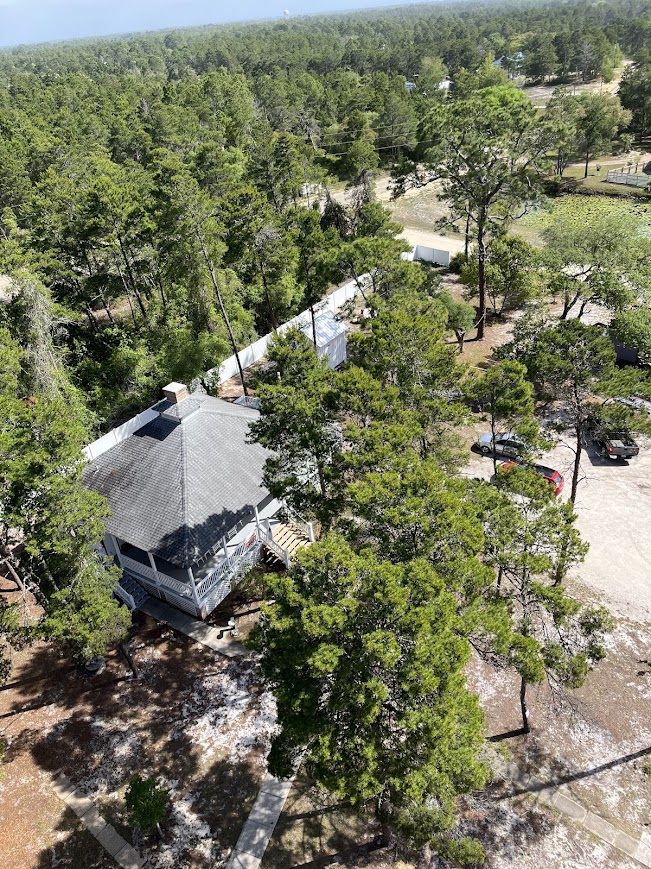

Visitors can climb the 103-foot structure—the tallest of the four lighthouses on the Forgotten Coast. It’s an easy climb but be prepared for a little hoisting up at the top to go out on the walk around. The view makes it worth the while.

Information: Crooked River Lighthouse Association 850-697-2732. Fee to climb.

Cape St. George Light
The story of this lighthouse involves a few miracles and lots of hard work by volunteers. The original tower, built in 1833 on Little St. George Island, had to be dismantled and reconstructed after storm damage in 1848, but it only lasted three years when it fell. Using the same materials, the lighthouse was reconstructed in 1853 further inland on the small island. Amazingly, this structure remained intact more than one hundred and fifty years guiding vessels to safety through Apalachicola Bay and beyond.
However, by 2005, it also collapsed because of the eroding shoreline. A sad occurrence but not the end of its story because a group of loving volunteers aided by the community of St. George Island and private and public funds brought it to life again—in the center of St. George. The volunteers salvaged more than 20,000 original bricks from the rubble left on Little St. George and rebuilt it along with a replica of the keeper’s quarters. It opened its doors in 2008. It’s an easy climb to the top and the quarters serve as museum and gift shop. Definitely worth the climb and visit.

Information: Cape St. George Light, 850-927-7745. Fee to climb.
Cape San Blas Lighthouse
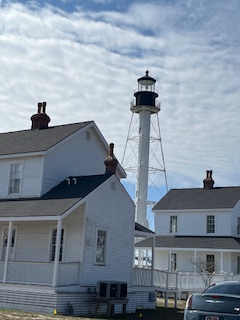
Finally! I visited the last of the Forgotten Coast lighthouses in early 2025 for the first time. Even though this lighthouse now resides in Port St. Joe, it once sat proudly on the little strip of land off the coast called Cape San Blas. Before it floated out to sea, it was rescued—just as it surely rescued ships needing guidance through many a dark night—by the city of Port St. Joe and brought to a park in the city center.
The two keeper’s quarters—one for the lighthouse keeper and another for the assistant keeper—did end up bobbing in the saltwater of the bay until rescued and brought ashore to serve as museum and gift shop homes.


A story often told at the St. Marks lighthouse involves one of the keepers who had been transferred to St. Marks from Cape San Blas. The wife was not pleased with the lack of room and location of St. Marks. Seeing the two large keeper’s quarters of the Cape San Blas lighthouse, I can see why. The homes are separate from the skeletal lighthouse and quite spacious.
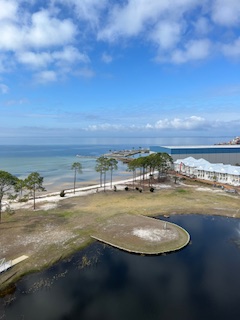
Built approximately one hundred thirty-five years ago, this lighthouse guided ships around the shoals that surrounded the cape. Its beacon could be seen ten miles out to sea. Tropical Storm Isaac in 2012 took away much of the lighthouse’s shoreline, so the city moved to a more protected site on St. Joseph Bay in 2014. Today it is a highlight of any visit to St. Port Joe. Visitors may climb the tower and enjoy breathtaking views of the bay and barrier strips of land that make up Cape San Blas and St. Joseph Peninsula.
Information: Cape San Blas Lighthouse, 850-229-1151.
 P.C. ZICK