
I’ve long had a love affair with sea turtles. It might have started when I learned the amazing life history of this species. It only grew after my experience first as a volunteer member of a sea turtle patrol on Matanzas Beach, Florida, twenty years ago. Then fifteen years ago, I was a part of a team tasked with saving sea turtles from the tar balls on Florida’s Panhandle coast in the months after Deepwater Horizon in my job with Florida Fish and Wildlife Conservation Commission (FWC).
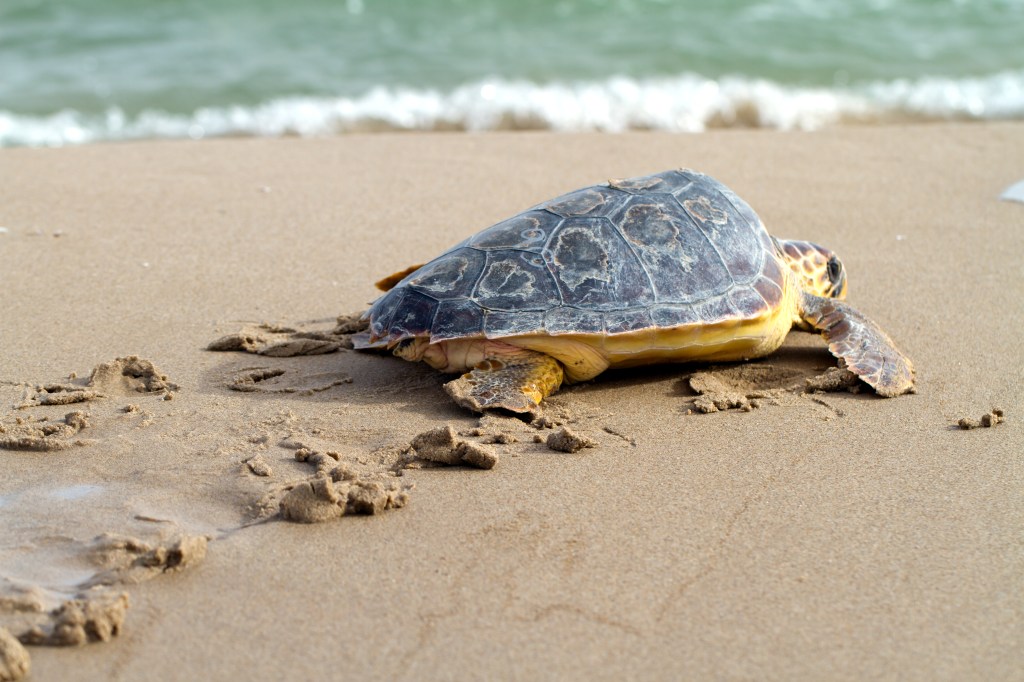
Sea turtle nesting season has begun in Florida. In March, along Florida’s southeast Atlantic coast from Brevard County south to Broward County, they begin the nesting process. Nesting begins on the Gulf Coast or north Florida beaches in April or May. Because Florida’s shorelines provide important nesting habitat for several species of threatened and endangered sea turtles, beachgoers can impact either he success or failure of the nests. Once the eggs are laid, it’s a waiting game until they hatch later in the summer and fall. But first those nests need to be protected on Florida’s busy beaches. If you visit Florida’s coast from March through November, please follow the guidelines from FWC—listed at the end of this post—for ensuring a successful birthing season for these special animals. But first, here’s my story of the early stages of my burgeoning love.
Several years ago, I gave birth to a sea turtle on Matanzas Beach on Florida’s Atlantic Coast. Well, not literal birth, but I helped a hatchling go to the sea.
(Photo from 2005, P.C. Zick)
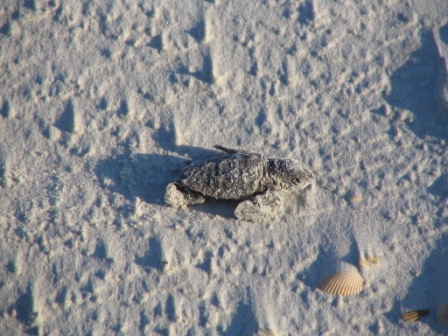
Volunteering as a sea turtle patroller requires walking the beach before 7 a.m. By the end of the summer, many of the volunteers have decided it is too much. The staff who run the sea turtle program call those of us who make it through the entire season the “dedicated ones.” To me, the reward for the early walks would pay off once the hatchlings emerged later in the summer, so I stayed for the whole season.
One morning in June 2005, I walked alone on the beach near the Matanzas Inlet. My patrol partner walked the north end of the beach, nearer St. Augustine. We carried our cell phones to call in reports and a stick to mark potential nests. That morning, I noticed a pattern of swishes in the sand, starting at the tide line and heading toward the dunes, but the patterns looked small for the flippers of the loggerhead, which is the more common of the sea turtles in Florida. They can weigh up to 275 pounds. I walked away without leaving my stick, but as I continued my patrol, I knew nothing could have left marks in the sand in such symmetry. I called the office, reported its location and placed my stick in the sand so the biologists would be able to find it. Later it became a confirmed nest. Matanzas North Nest #3 may have been the official title, but from that day forward, I thought possessively of it as mine.
After seventy days of incubation passed, the biologists decided it was time to dig up the nest to see if any of the eggs were viable. Fortunately, they remembered to call me to witness the process. They had barely scratched the surface when they found a hatchling. It barely moved at first, and the biologist conducting the dig put it in a box of wet sand until it starting moving around in the sand.
They continued digging and eventually found the remains of 120 hatched eggs and four eggs that had gone bad. These are pretty good statistics, but there is no guarantee all 120 of the hatchlings made it to the sea. Those of us gathered on the beach kept all predators away from this lone straggler, but the other hatchlings didn’t have that protection when they emerged, mostly likely the night before.

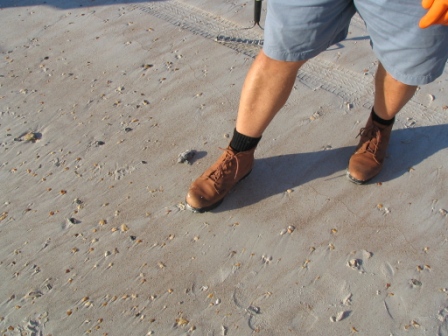
When the hatchling began moving around in the box, a volunteer placed it on the sand next to the nest so it might remember the precise location of emergence. If this one turns out to be a female, in approximately thirty years this same turtle most likely will come ashore at Matanzas and lay its first batch of eggs. The scientists believe the turtles tap into the Earth’s magnetic field while in the nest.
“My baby” sea turtle began its long walk to the sea following its instincts. A group of high school biology students formed a protective circle with the rest of us. Morning visitors to the beach, along with their vehicles, already competed for space. We left our baby a wide berth, so nothing could impede its determined yet slow walk to the sea.
As the tide receded, the hatchling encountered some difficulty when the first wave hit it, but it knew just what to do—it just didn’t have the strength yet to swim out far enough not to be swept back in. Repeatedly, we watched as it attempted to go back into the ocean. We cheered each time it managed a ride and commiserated each time we saw it come back toward us.
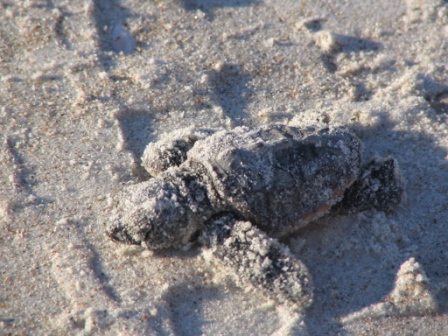
“Watch your feet,” one of the biologists yelled when the wave swept the hatchling back toward those of us forming its shield.
Barely two-inches long, this baby looked no bigger than the sack of eggs left by sharks on the beach. The hatchling tried again, this time managing a five-foot entry into the sea, only to be swept back onto the beach again.
And then a big wave came as we cheered, but “my baby” came back near my feet—belly up. The soft under belly, black and white spotted, faced me as its flippers frantically tried to right itself.
One of the biologists picked it up, walked out into the ocean for more than ten feet, and let the sea turtle go into its world undersea.
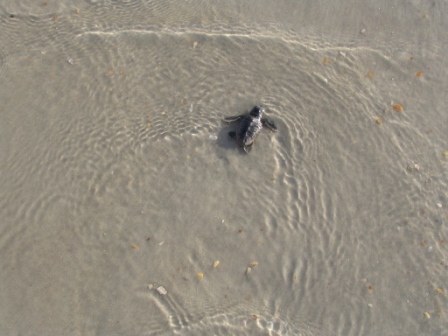
In one hour, this baby had been pulled from the sand, crawled for the first time and then swam away to fend for itself in the sea. We had done all we could to protect it. The rest was up to nature and the sea grasses will protect it in the coming years.
“Safe passage,” I whispered.
Luckily, the Deepwater Horizon oil spill was five years away, so maybe this little hatchling made it before the tarballs entered its habitat. The story of my role in protecting those nests will have to wait for another post.
For now, if you go to either coast of Florida from March through November, please follow the guidelines set by the Florida Fish and Wildlife Conservation Commission. And if you see either the female coming ashore to lay its eggs or hatchlings emerging later in the summer and fall, give them space and keep others away from them.
Guidelines for Beachgoers
- Lights out – Any lighting can misdirect and disturb nesting sea turtles and their hatchlings, leading them away from the ocean and toward potential danger. To prevent this, beachgoers should use natural starlight to see while on the beach at night and avoid using flashlights or cellphones. Anyone living along or visiting Florida beaches can do their part by putting porch, parking or deck lights out when not in use and closing curtains after dark to avoid disorienting nesting and hatchling sea turtles on the beach.
- Admire from afar – While it can be exciting to witness sea turtles on the beach, getting too close (50 feet or less) to nesting sea turtles can cause them to leave the beach before they complete the nesting process. If an animal changes its behavior, you’re likely too close. Remember – it is illegal to harm or disturb nesting sea turtles, their nests and eggs, or to pick up hatchlings.
- Clear the way at the end of the day – Female sea turtles expend large amounts of energy crawling out of the surf and far enough up the sand in order to dig and lay nests in spots that are less vulnerable to the tides. Obstacles on the beach can entrap and prevent them from nesting as they crawl across the sand to lay their eggs. Trash, holes in the sand and other obstacles can also prevent sea turtle hatchlings from reaching the water once they emerge from their nests. Food scraps attract predators, such as raccoons and crows, that prey on sea turtle hatchlings. Litter on beaches can entangle sea turtles, birds and other wildlife. Properly stash or recycle all trash, fill in man-made holes in the sand, and remove all beach toys, gear and furniture from the sand before sunset. Fishing line can be deadly to sea turtles, waterbirds, and other wildlife, so be sure to dispose of it properly.
- For more information about nesting sea turtles and how you can help, visit the sea turtle site at MyFWC.com. Report any sea turtles that appear sick, injured, entangled or dead to the FWC’s Wildlife Alert Hotline at 888-404-FWCC (3922).

 P.C. ZICK