
To start off Earth Day 2025 week, I’m offering my Florida Fiction novel, Trails in the Sand, for free downloads April 21-25.
What does this novel have to do with Earth Day? Everything.
Book Blurb: When environmental writer Caroline Carlisle sets off to report on endangered sea turtles during the Deepwater BP oil spill in 2010, she also uncovers long-kept secrets that threaten to destroy her family. The situation is complicated further by Caroline’s love for her late sister’s husband, Simon. An uproar ensues as Caroline’s southern family embarks on a collision with its past and future. At the same time, the oil from Deepwater Horizon continues to spew forth into the Gulf of Mexico and onto its beaches, creating an urgency to save Florida’s wildlife. It’s in this atmosphere that Caroline discovers the truth about her family and writes noteworthy articles about wildlife rescues.
Her relationship with both her sister, who died from an eating disorder, and her mother, whose grief and depression over the death of her brother years earlier shatters Caroline’s own secrets. An adventure involving parenthood and children and mental illness, Trails in the Sand uses the real events of 2010 as the backdrop for the psychological love stories unfolding with some humor and satire on the world of Florida environmental politics.
If you enjoy books that combine fiction with real world events, you’ll enjoy how the timeline and facts from Deepwater Horizon’s oil spill serve as the backdrop to Trails in the Sand, the recipient of a Green Book Award.

Earth Day 2010 was marked by the explosion in the Gulf of Mexico that killed eleven men and spewed forth oil into the waters off the coast of Louisiana. Four million barrels of oil flowed from the damaged Macondo well over an 87-day period, before it was finally capped on July 15, 2010.
At the time of the explosion, I worked for the Florida Fish and Wildlife Conservation Commission as a public relations director. However, I was attempting to transition out of my job because I had recently married, and I planned to move to Pittsburgh where my husband worked.
In addition, wo weeks prior to the Deepwater Horizon disaster, twenty-nine men had been killed in the Massey coal mine in West Virginia when gases and coal dust ignited. The news media in Pittsburgh–just a few hours from the mine–had been all over this disaster.
These two events have several things in common. The disasters could have been prevented if proper safety standards had been followed by the companies. And they could also have been avoided if the government who created those standards had actually enforced them.
As a writer, I felt drawn to both stories because of how they touched my life. But that book, Trails in the Sand, also addresses several personal issues about family and finding a way to heal the wounds that stretch back generations. All the while the oil spills and the West Virginia community deals with the shock of losing so many lives.
I began writing Trails in the Sand in the months after Deepwater Horizon and the Upper Big Branch coal mine explosion. Forty deaths within two weeks of one another pushed me to write something that might serve as a reminder of two preventable disasters in 2010. Both events touched my life in some way, and both made their way into the writing of Trails in the Sand.
I made the trip back and forth between the two states sixteen times in 2010. I conducted meetings from a cell phone in airports, highway rest areas, and at a dining room table from our small temporary apartment in Pittsburgh.
Every time I started to give my two-week notice to my supervisors, something happened, and my wildlife biologist bosses pleaded with me to stay. During a crisis, the spokesperson for a company or agency suddenly becomes a very important part of the team. Scientists become speechless when looking in the face of a microphone. And all their scientific facts and figures must be distilled and translated into sound bites for the public. That was my job at that time.
Nothing much happened in those early days of the oil spill for the wildlife community, although as a communications specialist, I prepared for worst-case scenarios, while hoping for the best. Partnerships between national and state agencies formed to manage information flowing to the media. By May, some of the sea turtle experts began worrying about the nesting turtles on Florida’s Panhandle beaches, right where the still gushing oil might land. In particular, the scientists worried that approximately 50,000 hatchlings might be walking into oil-infested waters if allowed to enter the Gulf of Mexico after hatching from the nests on the Gulf beaches.
An extraordinary and unprecedented plan became reality, and as the scientists wrote the protocols, the plan was “in direct response to an unprecedented human-caused disaster.”
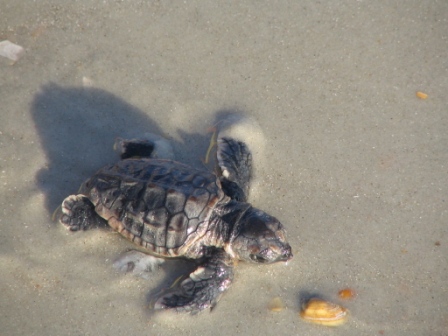
When the nests neared the end the incubation period, plans were made to dig up the nests and transport the eggs across the state to Cape Canaveral, where they would be stored until the hatchlings emerged from the eggs. Then they would receive a royal walk to the Atlantic Ocean away from the oil-drenched waters of the Gulf.
The whole project reeked with the scent of drama, ripe for the media to descend on Florida for reports to a public hooked on the images of oiled wildlife. Since I was in transition in my job, they appointed me to handle all media requests that came to the national and state agencies regarding the plan. From my new office in Raccoon Township, Beaver County, Pennsylvania, I began coordinating media events and setting up interviews with the biologists.
As the project began in June 2010, I began writing Trails in the Sand. At first, I created the characters and their situations. Then slowly I began writing about the oil crisis and made the main character, Caroline, an environmental reporter who covered the sea turtle relocation project. Then suddenly I was writing about her husband, Simon, who mourned the loss of his cousin in the coal mine disaster in West Virginia. I didn’t make a conscious effort to tie together the environmental theme with the family saga unfolding, but before too long, I realized they all dealt with restoration and redemption of things destroyed. As a result, the oil spill and the sea turtles became a metaphor for the destruction caused by Caroline and her family. I wish the disasters never occurred. But I can’t wave a wand and erase the past. But with strokes on the keyboard, I could create something lasting that might make a difference. At the very least, I made that attempt. And the result is Trails in the Sand.
 P.C. ZICK