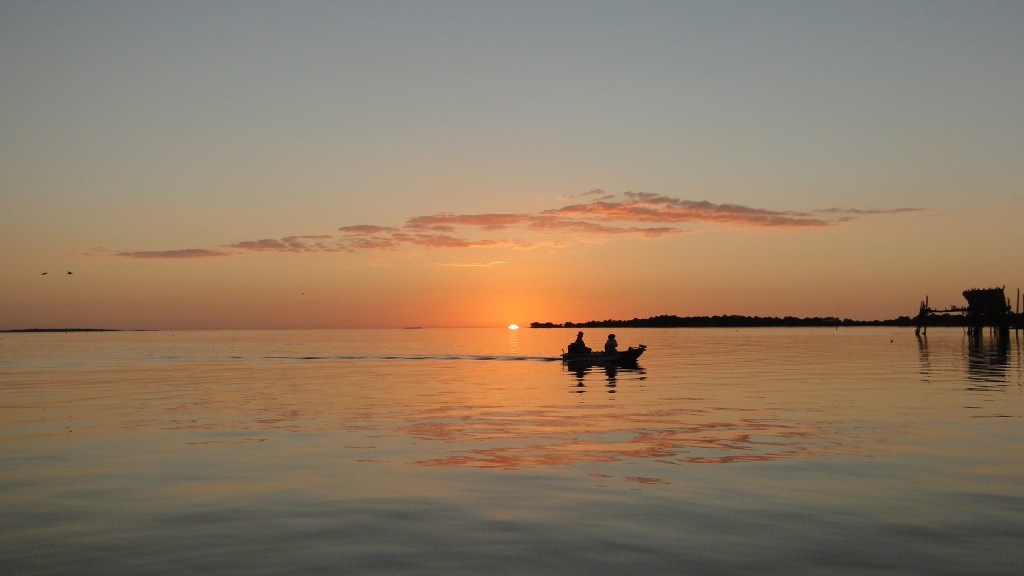
When I moved to a small north Florida town in 1980, I loved the location in the middle of the state. We could drive to the Atlantic Ocean in less than two hours, or we could be sitting at a bar overlooking the Gulf of Mexico in less than ninety minutes.

Harry Cruise, a Florida author from Gainesville, wrote about this phenomenon in an essay in his book Florida Frenzy. Cruise, from south Georgia, eventually took up residence in Gainesville, Florida, where he taught creative writing at the University of Florida.
“I can leave the place where I live [Gainesville] a couple of hours before daylight and be on a deserted little strip of sand call Crescent Beach…while the sun lifts out of the Atlantic Ocean…I can leave the beach and in three hours be out on the end of a dock, sitting in the Captain’s Table [a Cedar Key institution until destroyed by a hurricane]…while the sun I saw lift out of the Atlantic that morning sinks into the warm, waveless Gulf of Mexico. It makes a hell of a day.”
I fell in love with the sleepy fishing village of Cedar Key on my first visit there more than forty years ago. Many years, I requested a trip there to celebrate my birthday. Dock Street sits right on the Gulf of Mexico and hosts most of the town’s bars, restaurants, and shops. Two blocks over, 2nd Street serves as the village’s main street. The Island Hotel Restaurant is housed in one of the oldest structures on the key. Built in 1859, it was constructed to last even when the Union Army invaded and destroyed much of the town.

Cedar Key, with its deep harbor and lush trees and abundant seafood stood on the cusp of becoming one of Florida’s most important ports by the mid-1800s. It became a major shipping port for lumber and oysters. And the various keys were mined for their abundance of cedar trees to make pencils.
Several events—manmade and natural—kept it from becoming the “Tampa” of the Sunshine State. First, during the Civil War the Union soldiers burned everything they could because the port was seen as strategic for the Confederate Army including the first Atlantic to Gulf railroad, which had been completed in 1861. It started in Fernandina Beach north of Jacksonville and meandered southwest to Cedar Key.
After the war ended, the town began to revive itself minus a railroad terminus. However, steamships came in and out of the port. When Henry Plant tried to bring the cross Florida rail line back during the Gilded Age, he found resistance with the residents of Cedar Key. And the coveted cedar trees had not been replanted, which depleted the one source that had kept the town going even after the railroad was gone. Then a major hurricane in 1896 destroyed the village once again, and changed the destiny of the western coast of Florida. Plant moved south to Tampa and set up shop.

Today, the village of Cedar Key is a fishing village and an artist colony with those in the know making it their destination for getaways. I finished my novel Tortoise Stew in a friend’s cottage on one of the bayous off State Road 24, which ends at the corner of Dock Street and the Gulf of Mexico.
Hurricanes have attempted to destroy Cedar Key over the years, most recently in 2023 and 2024, but the spirit of the village and its residents is resilient. And it’s a place where no one is a stranger for long. Recently, two teenage girls lost their way on paddle boards. They washed up on one of the outer keys but weren’t found until the next day. I watched the rescue efforts via social media. Folks came with their boats from miles around to assist in the rescue. Fortunately, the two were found the next morning sheltering in place and shivering until the warmth of the residents enveloped them and brought them back to safety.
Its quiet and simple nature may not be for everyone. But it suits me. If I want noise and constant motion and crowded streets, I can always head south.
Next week, I’ll come back to Cedar Key to explore the unique lighthouse that sits three miles into the Gulf on Seahorse Key. In the meantime, visit the Cedar Key Chamber of Commerce’s website, to learn about the village’s art galleries, community garden, museums, marina, and accommodations.


I wrote Tortoise Stew, the first book in my Florida fiction series, while looking out over the bayous off Cedar Key, Florida. The setting served me well as I wrote about wildlife–both human and animal–that create the wackiness that is the Sunshine State. A recent reader wrote to tell me, “I really enjoyed Tortoise Stew and rate it with the books I have read by [Carl] Hiassen.“
 P.C. ZICK