
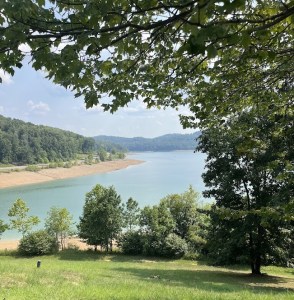
Photo: On the dam trail in Tygart Lake State Park
By P.C. Zick – @pczick.bsky.social
We stumbled upon a unique area in West Virginia. Each year we visit family in Blacksburg, Virginia, and Pittsburgh, Pennsylvania. The three hundred miles between them takes us through West Virginia and the New River Gorge, which we’ve visited several times on our trips. Last August, I found another spot, still in West Virginia, at Tygart Lake State Park outside of Grafton, West Virginia.
When we reached Grafton, we were stopped by one of the longest and slowest trains I’ve ever encountered. Mostly empty coal cars on the way to pick up their loads. We waited for ten minutes hopeful to see a caboose eventually. Then the slowest train in the world stopped—no caboose or engine in sight. When nothing seemed to be happening, I made an executive decision and turned our car around and headed almost in the direction where the park lay. GPS would reroute and catch up, which it did almost immediately, and we were treated to a lovely drive through the mountains of western West Virginia. On subsequent trips to sightsee, we took the same exact route.

Grafton lies in the heart of coal country and the placement of the Baltimore and Ohio railway for access to the Ohio River in Wheeling led to the creation of a booming railroad town by 1852 when the line was completed.
Photo courtesy Canva
Lodging at the park consists of the usual camping sites, cabins, and rooms in the main lodge. We opted to stay in the lodge where our room opened to views of Tygart Lake with trails leading to the dam that formed it from the Tygart Valley River. The lodge itself had a lovely dining room and deck with perfect views of the lake and hills surrounding it.
Photo by P.C. Zick – View of the lodge from lake


The dam, built in 1938 by the Army Corps of Engineers for the Pittsburgh District assists the area with flood control and water conservation.
Photo by P.C. Zick – Tygart Dam Spillway – Length 1,921′ – Height 230′
On one of our day trips, we knew we had to visit the small town of Philippi nearby because it boasted one of the few remaining covered bridges in the country. Built in 1852, the bridge allowed the turnpike—now U.S. Route 250—to cross the Tygart Valley River and head to Fairmont, West Virginia. It is considered a masterpiece and today much of the original structure still stands and continues to offer passage over the river.
Photo by P.C. Zick – Philippa Covered Bridge


When we arrived at a parking lot near the base of the river, we learned a surprising tidbit about that bridge. The Philippi Covered Bridge also witnessed the first notable land battle of the Civil War. Although minor in comparison to what happened later in the war, June 3, 1861, saw a skirmish based on one woman’s attempt to thwart a possible encounter between the two sides.

Word had come that 1,400 Union troops were headed to Grafton to protect the B&O Railroad and would soon be crossing the river at Philippi. One woman who lived on the hill above the bridge wanted to warn her son about the Union troops. She shot her pistol in the air to scare her son off his horse. Union Col. Frederick Lander had been told not to fire until he heard a signal gun, so when he heard the pistol, he ordered his artillery to open fire. The unprepared and green Confederate soldiers lost the battle overnight.
The Union soldiers were able to occupy the town for a brief time. There were few casualties, but the first amputation of the war did occur. And it catapulted Gen. George McClellan, who ordered the troops to Grafton, to national prominence. By July, he had been named commander of the Army of the Potomac.
Photo: Civil War Archives – Gen. George McClellan

Some of my best travel experiences occur when I allow the road to take me where it will instead of the other way around. The trip to western West Virginia showed me once again that history may be preserved in museums, but it lives where it happened.

after a day of sightseeing in Philippa
I’m always interested in stories about Gen. George McClellan, who eventually fell out of favor with President Lincoln. My great-grandfather, Harmon Camburn, wrote about his experiences during the Civil War as a soldier with Michigan’s 2nd Infantry. His regiment received a review by General McClellan and President Lincoln on October 29, 1861, at their camp along the Potomac.
All being in readiness, every man became perfectly motionless. Not a move could be seen. Not a sound broke the perfect stillness until General McClellan and his brilliantly mounted staff rode upon the field accompanied by President Lincoln and his suite. At this first sight of this glittering cavalcade, the cannons boomed a national salute. As soon as the deafening thunder died away, the President and the General, followed by all their train, rode around the valley in front of the line, and viewed the troops. As each successive division was reached, the drums rolled, flags dipped, and the soldiers presented arms. As soon as the circuit of the field had been made, the President and the General took their stand in a convenient position, and the troops passed in review before them. The Infantry moved in “double column closed en masse,” that is, one hundred men abreast with each succeeding rank as close to the preceding one as men can walk with freedom.
Despite McClellan’s removal after the Union’s disastrous Seven Days Battle in July 1862, the soldiers all held him in high esteem, or at least my great-grandfather did. When his first son, my great-uncle, was born in 1865, he named him George McClellan Camburn.

 P.C. ZICK